
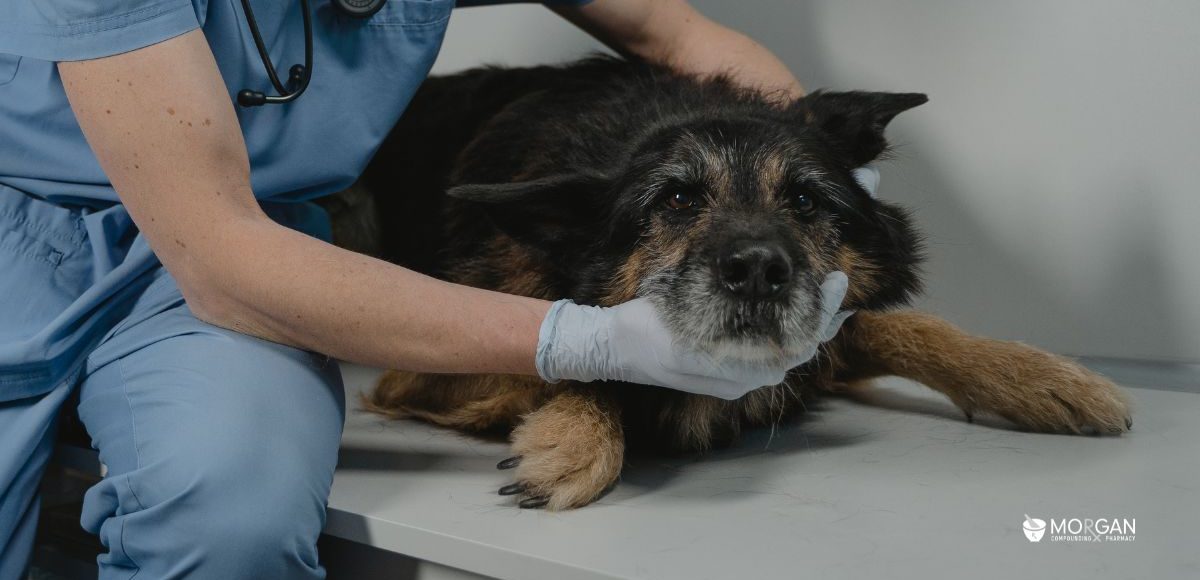
Canine Epilepsy Medications: Exploring Compounded Potassium Bromide, Gabapentin, and Diazepam for Georgia Pets
Dogs aren’t just pets — they’re family. When a dog experiences a seizure, it can be a frightening and heartbreaking experience for any owner.
Thus, seizures significantly impact the quality of life for both the pet and the family. While some dogs experience infrequent episodes, others require long-term management to reduce the frequency and severity. The good news is that with consistent, tailored care plans, many dogs with epilepsy live long, happy, and comfortable lives.
Because every dog is unique, seizure management is rarely universal. So, finding the right balance usually needs a customized approach. This is where pharmacy partners, like Georgia’s Morgan Compounding Pharmacy, play a supportive role — helping veterinarians provide precise, safer, and easier-to-administer therapies.

Why Do Dogs Have Seizures?
Think of a seizure as a sudden, temporary electrical storm in the brain. Normally, neurons communicate through organized electrical signals. During a seizure, a group of neurons becomes hyperexcitable, firing high-frequency bursts of energy all at once. This surge of electricity overrides the brain’s normal functions, causing the dog’s body to lose control.
These electrical storms are generally triggered by one of three underlying categories:
- Reactive Seizures: These occur when a healthy brain reacts to a problem elsewhere in the body. Common triggers include metabolic issues like liver disease, kidney problems, or low blood sugar. Ingestion of toxins like Xylitol and alcohol may also induce seizures.
- Structural Seizures: Usually caused by a physical abnormality within the brain itself. It includes brain tumors, head trauma, or infectious diseases.
- Idiopathic Epilepsy: This is the most common cause of seizures — a condition of unknown origin — and is typically made only after every other cause has been ruled out. It usually emerges in dogs between 6 months and 6 years of age.
Depending on where it originates, the dog may experience anything from a brief dazed look to leg paddling and loss of consciousness.
What Medications are Prescribed for Canine Epilepsy & Seizures?
Veterinarians use a variety of anticonvulsants to manage epilepsy. However, compounding allows these standard therapies to be adapted to your dog’s specific weight, safety needs, and taste preferences.
Potassium Bromide
One of the oldest and most reliable anticonvulsants in veterinary medicine. It is frequently used for dogs that don’t respond well to other treatments or those with gastrointestinal or liver concerns.
- Clinical data published in the Journal of the American Veterinary Medical Association showed that 72% of dogs experienced a 50% or greater reduction in seizure frequency after starting Potassium Bromide.
- It’s available in capsules (500 mg or custom) and oil-based oral suspensions (250 mg/mL, 500 mg/mL, or custom). The latter supports gastrointestinal tolerance.
Phenobarbital
A common first-line defense against epilepsy that works by calming overactive brain activity.
- In a comparative study published in the Journal of the American Veterinary Medical Association, Phenobarbital was shown to manage seizures in 85% of dogs within the first six months of therapy.
- Compounding a 200 mg/mL oil oral suspension allows a veterinarian to dose precisely for toy dogs and giant breeds.
- Considerations: Sedation as a possible side effect.
Gabapentin
Often used as an adjunct therapy for seizures, Gabapentin also helps with neuropathic pain and anxiety.
- In a study on dogs with difficult-to-treat epilepsy published in The Veterinary Record, the addition of Gabapentin resulted in a significant reduction in seizure frequency for over half of the participants.
- The Xylitol Danger: Human-grade Gabapentin products contain Xylitol, a highly toxic (and potentially fatal) substance to dogs.
- Compounding Advantage: Xylitol-free 100 mg/mL oil suspensions and 50 mg capsules, ensuring total safety for canine patients.
Zonisamide
A newer anticonvulsant with a low side-effect profile, making it an excellent choice for a multi-drug seizure protocol.
- According to a prospective study published in the Journal of Small Animal Practice, 9 out of 11 dogs with refractory epilepsy responded to Zonisamide as an add-on therapy, with an average reduction in seizure frequency of 70%.
- Formulated in 12.5 mg capsules or oil suspensions (100 mg/mL or custom) let veterinarians fine-tune the dose without having to split tiny, inaccurate tablets.
- Considerations: Zonisamide is a sulfonamide-based anticonvulsant. Although rare, it may trigger reactions in dogs with a sensitivity to sulfonamides.
Levetiracetam
Known for minimal liver metabolism, this medication is ideal for dogs with pre-existing liver issues.
- A comprehensive study published in BMC Veterinary Research found that 69% of dogs experienced a 50% or greater reduction in seizure frequency when Levetiracetam was added to their maintenance therapy.
- Designed in 100 mg/mL oil oral suspension, it can be compounded with flavored suspensions to make dosing less stressful for the dog and their owner.
- Considerations: It has a short half-life and often requires dosing three times daily.
Diazepam
While not for daily use, Diazepam is known for its fast-acting effect on prolonged seizures or status epilepticus.
- Observations published in the American Journal of Veterinary Research confirmed that rectal administration reaches therapeutic levels in the bloodstream within 10 minutes. Clinical trials in the Journal of Veterinary Internal Medicine revealed that this rapid at-home intervention successfully halts cluster seizures and reduces the need for emergency hospitalization.
In a seizure emergency, giving a pill is physically impossible. Compounded 10 mg/g rectal gel in pre-filled syringes with an attached flexible cannula can be used immediately. With specialized, bio-adhesive bases like MucoLox™ and VersaBase®, it ensures rapid absorption while eliminating leakage issues common with standard liquid solutions.
Why Compounding May Make All the Difference
While mass-produced, commercially made medications are prescribed for seizure management, they are not always a perfect fit for the unique needs of every dog. Veterinary compounding allows for a personalized approach that prioritizes both clinical precision and owner compliance.
- Custom Strengths for Unique Needs: Many life-saving seizure medications are not commercially available in the specific strengths dogs require. Compounding allows for the creation of custom-strength drugs, ensuring the patient receives the exact dose intended by the veterinarian without the risks associated with under- or over-medicating.
- Precision Dosing for All Breeds: Standard manufactured pills often come in one-size-fits-all doses. Compounding provides precise, weight-based dosing — ranging from tiny capsules for toy breeds to highly concentrated suspensions for giant breeds.
- Flavoring Options to Improve Compliance: Consistency is the most critical factor in successful seizure control. To make daily administration less stressful, oral medications can be formulated in pet-approved flavors such as tuna, triple fish, chicken, beef, or liver.
- Smaller Capsules for Easier Administration: For dogs having difficulty with large, bulky commercial tablets, medications can be compounded into significantly smaller capsules. These are easier for the pet to swallow and simpler for the owner to conceal in a small treat.
- Emergency Dosage Forms: During an active seizure, oral medication is not a viable option. Compounding provides life-saving alternatives, such as rectal gels with flexible cannulas and bio-adhesive bases, allowing owners to intervene safely and rapidly at home to halt prolonged seizure activity.
- Safety-First Formulations: Many human-grade liquid medications (like Gabapentin) contain Xylitol, an artificial sweetener that is highly toxic to dogs. Compounded veterinary formulas are designed Xylitol-free for patient safety.
Georgia Veterinarians Choose Morgan Compounding Pharmacy for Canine Epilepsy Medications
Addressing canine seizures requires a dedicated partnership between the veterinarian, the pet owner, and the pharmacist. At Morgan Compounding Pharmacy, we are proud to support the Georgia veterinary community with high-quality, customized medications.
Guided by veterinarians, compounded canine epilepsy medications provide flexibility, safety, and better outcomes for dogs.

From Alpharetta, we provide pharmaceutical support to Metro Atlanta and beyond, including Roswell, Johns Creek, Dunwoody, Sandy Springs, Peachtree Corners, Norcross, and Marietta. We ship prescriptions statewide.
For Georgia veterinarians, we have simplified the prescribing process with an organized Canine Veterinary Rx Form for easy prescribing.
How it Works
- Request Access to the Rx Form
- Request access from our team, and we’ll provide a password to download all available prescription order forms. The Canine Veterinary Rx Form lets Georgia veterinarians prescribe compounded medications for their patients.
- Complete the Patient and Prescriber Information
- Patient info: Name, date of birth, phone number, address, allergies, and email
- Prescriber info: Name, office number, office fax number, address, NPI, and DEA
- Select Medication and Dosage Strength
- Choose the medication you wish to prescribe
- Check the dosage strength or declare custom strength
- For specifics, detail the custom formulation
- Prescriber Authorization
- Review the Rx form.
- Authorize the prescription by initialing and signing the form. This confirms clinical necessity and ensures the compounded medication aligns with Georgia compounding law and patient chart documentation.
- Submit the Complete Form
- Fax: (770) 809-5048
- Email: pharmacist@morgancompounding.com
Once received, the Morgan Compounding Pharmacy team will process the prescription promptly. Our pharmacists will contact you if any clinical or regulatory concerns arise.
Addressing epilepsy is about more than just stopping seizures — it’s about giving a dog their life back.
For dog owners, ask our pharmacists about how compounded canine epilepsy medications may provide support.
For veterinarians, partner with Morgan Compounding Pharmacy today to optimize your care plans for your patients.
References
- Absorption of diazepam after its rectal administration in dogs. (1995, December 1). American Journal of Veterinary Research. Link
- Bhatti, S. F., De Risio, L., Muñana, K., Penderis, J., Stein, V. M., Tipold, A., Berendt, M., Farquhar, R. G., Fischer, A., Long, S., Löscher, W., Mandigers, P. J., Matiasek, K., Pakozdy, A., Patterson, E. E., Platt, S., Podell, M., Potschka, H., Rusbridge, C., & Volk, H. A. (2015). International Veterinary Epilepsy Task Force consensus proposal: medical treatment of canine epilepsy in Europe. BMC Veterinary Research, 11(1), 176. Link
- Boothe, D. M., Dewey, C., & Carpenter, D. M. (2012). Comparison of phenobarbital with bromide as a first-choice antiepileptic drug for treatment of epilepsy in dogs. Journal of the American Veterinary Medical Association, 240(9), 1073–1083. Link
- Managing seizures. (n.d.). Cornell University College of Veterinary Medicine. Link
- Packer, R. M., Nye, G., Porter, S. E., & Volk, H. A. (2015). Assessment into the usage of levetiracetam in a canine epilepsy clinic. BMC Veterinary Research, 11(1), 25. Link
- Podell, M. (1995). The use of diazepam per rectum at home for the acute management of cluster seizures in dogs. Journal of Veterinary Internal Medicine, 9(2), 68–74. Link
- Therapeutic serum drug concentrations in epileptic dogs treated with potassium bromide alone or in combination with other anticonvulsants: 122 cases (1992-1996). (1998, November 15). PubMed. Link
- Treatment with gabapentin of 11 dogs with refractory idiopathic epilepsy. (2006, December 1). The Veterinary Record. Link
- Von Klopmann, T., Rambeck, B., & Tipold, A. (2007). Prospective study of zonisamide therapy for refractory idiopathic epilepsy in dogs. Journal of Small Animal Practice, 48(3), 134–138. Link