
Compounded Topical Hormone Creams for Women in Georgia
Perimenopausal and Menopausal symptoms can range from mild discomfort to changes that greatly affect daily comfort, sleep, and intimacy. As hormone production shifts during perimenopause and menopause, some women may notice changes such as:
- Changes in sleep quality or sleep patterns, which may be influenced by fluctuating progesterone and estrogen levels
- Hot flashes and night sweats, commonly associated with declining estradiol
- Vaginal dryness, urinary discomfort, or pain during sex, related to reduced estrogen support of vaginal and urinary tissues
- Gradual changes in bone density over time, influenced by lower estrogen levels
- Reduced sexual desire or changes in energy, which may be associated with lower testosterone levels in some women
Bioidentical hormone replacement therapy, or BHRT, is a form of hormone therapy that uses hormones that are chemically identical to the ones naturally produced by the human body. BHRT may come in topical hormone creams, such as progesterone, estradiol, and testosterone, which may be prescribed to address symptoms like vaginal dryness and pain during sexual intercourse. Through compounding, prescribers can tailor strengths and combinations to individual needs.
Hormone levels naturally shift as women move through different life stages. While these are normal, the effects often depend on which hormones are changing and how the body responds.
Key Hormones in BHRT and What Happens When They're Out of Balance
Progesterone
- Role: Helps regulate the menstrual cycle and supports the uterine lining during the reproductive years.
- Imbalance Symptoms: Low progesterone can lead to irregular periods, anxiety, mood swings, sleep disturbances, and estrogen dominance symptoms such as breast tenderness or heavy periods.
Estradiol
- Role: The primary estrogen during reproductive years, involved in vaginal tissue health, temperature regulation, bone density maintenance, and cardiovascular function.
- Imbalance Symptoms: When estradiol is low, symptoms can include hot flashes, night sweats, vaginal dryness, low libido, and increased risk of bone loss and heart disease.
Estriol
- Role: A weaker estrogen that is highest during pregnancy and typically present in smaller amounts otherwise. It plays a role in vaginal and urinary tract health.
- Imbalance Symptoms: Low levels may contribute to vaginal dryness, urinary tract discomfort, and thinning of vaginal tissue, especially after menopause.
Testosterone
- Role: Present in women in smaller amounts and contributes to sexual desire, energy levels, mental clarity, and overall well-being.
- Imbalance Symptoms: Low testosterone can cause fatigue, decreased libido, mood changes, reduced muscle mass, and a general lack of motivation or drive.
DHEA (Dehydroepiandrosterone)
- Role: A precursor hormone that the body converts into estrogen and testosterone. Supports energy, libido, mood, immune function, and bone strength.
- Imbalance Symptoms: Low levels may lead to fatigue, reduced libido, poor immune response, and mood instability.
- Topical Use: Often used in vaginal creams to help with vaginal atrophy, dryness, and urinary discomfort, especially in postmenopausal women.
Pregnenolone
- Role: Known as the “mother hormone,” it’s the precursor to many other hormones including progesterone, DHEA, and cortisol. It supports memory, cognition, mood, and stress response.
- Imbalance Symptoms: Low levels may cause brain fog, memory issues, mood changes, and fatigue.
- Topical Use: Less common but available in compounded creams for neurological and adrenal support.
Cortisol (or hydrocortisone in low-dose bioidentical form)
- Role: Involved in stress response, inflammation regulation, and blood sugar control.
- Imbalance Symptoms: Chronic low cortisol (often seen in adrenal fatigue) can cause fatigue, low blood pressure, dizziness, and stress intolerance.
Topical Use: Very low-dose compounded hydrocortisone may be used in some BHRT protocols under medical supervision.
Examples of Compounded Hormone Creams for Perimenopause and Menopause
Compounded Progesterone Cream
- Dosage Strengths: Available in 5 mg, 25 mg, 50 mg, 100 mg, and custom mg, as guided by your prescriber.
- Study Highlight: In a small study published in the journal Blood, postmenopausal women who used 20 mg per day of topical progesterone cream for four weeks experienced significant symptom relief on a menopause symptom scale.
- How to Use: Apply the prescribed amount of cream and rub in well for one to two minutes. How many times per day you use it should follow your prescriber’s directions exactly.
“Topical progesterone cream at a daily dose of 20 mg significantly relieves menopausal symptoms in postmenopausal women without adversely altering prothrombotic potential.”
Source: Blood
Compounded Estradiol Cream
- Dosage Strengths: 0.1 mg, 0.2 mg, 0.5 mg, 1 mg, and custom mg, as directed by your prescriber.
- Study Highlight: Published in the International Journal of General Medicine, a review noted the significant reduction in the frequency and severity of hot flashes in women who received active estradiol emulsion.
- How to Use: Rub in the prescribed amount until absorbed. Follow your prescriber’s instructions for timing and daily use.
Compounded Estriol-Estradiol Cream
- Dosage Strengths: As a bi-estrogen therapy (Bi-Est), it’s available in 80% estriol and 20% estradiol in 0.5 mg, 1 mg, 2 mg, 3 mg, and custom mg, which is guided by your provider.
- Study Highlight: An observation study published in BMC Women’s Health showed that Bi-Est, along with other regimens, supported menopause-related symptoms. Changes reported include 25% reduction in emotional lability and irritability and 22% reduction in anxiety.
- How to Use: Gently apply and rub the indicated amount until absorbed fully. Observe prescriber-guided instructions for application schedules.
Compounded Estriol-Estradiol-Estrone Cream
- Dosage Strengths: A tri-estrogen therapy (Tri-Est) that comes with estriol, estradiol, and estrone. Your healthcare provider determines the dosage strengths based on your specific needs and clinical presentations.
- Study Highlight: The cohort study published in BMC Women’s Health followed 296 women who were on compounded bioidentical hormone regimens. Reports showed that topical estrogen blends, including Tri-Est, resulted in symptom changes including hot flashes and night sweats.
- How to Use: Use of this cream should follow your prescriber’s plan. Timing and frequency are based on specified instructions.
Compounded Testosterone Cream
- Dosage Strengths: Available in 0.5 mg, 1 mg, 2 mg, 3 mg, and custom mg, as prescribed by your clinician.
- Study Highlight: Published in Fertility and Sterility, a systematic review examined over 3,000 post-menopausal women. Researchers found that those in testosterone groups had more satisfying sexual episodes, more overall sexual activity, more orgasms, and higher desire scores compared with placebo. These were observed across both naturally and surgically menopausal women.
How to Use: Follow the dosing schedule provided by your prescriber. Do not exceed the prescribed amount.


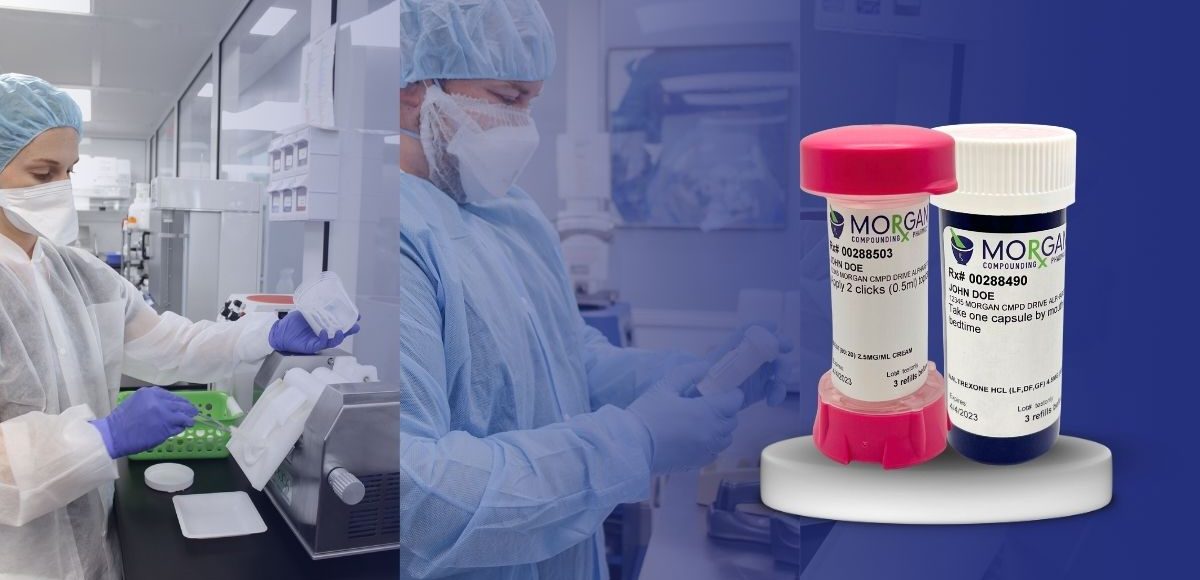
With the Topi-Click applicator, get the prescribed amount precisely. A single click is equal to 0.25 ml while two clicks for 0.5 ml, and four clicks for 1 ml.
These compounded creams are generally well-tolerated. However, possible side effects include irritation, itching, or burning at the application site and vaginal discomfort. Consult with your clinician upon experiencing such so your dosage can be adjusted.
These are only a few of the many formulations available at Morgan Compounding Pharmacy. Please reach out to obtain a comprehensive list of our exclusive formulations.
Why Application Site Matters with BHRT Hormone Cream
When it comes to bioidentical hormone replacement therapy (BHRT) creams, where you apply the cream is just as important as taking it consistently. Proper absorption is key to getting the full therapeutic benefit, and that starts with choosing the right areas on your body.
Hormone creams are designed to be absorbed through the skin and into the bloodstream. Areas where the skin is thinner and has more blood vessels—such as the inner arms, inner thighs, or abdomen—are ideal for this. These regions have a higher concentration of capillaries just below the surface, allowing the

hormones to enter the circulation more efficiently and consistently.
Applying the cream to thicker or less vascular areas (like the soles of the feet or palms) may result in poor absorption and reduced effectiveness. For optimal results, it’s essential to follow your provider’s instructions and rotate application sites among the recommended areas to maintain steady hormone levels and avoid skin irritation.
By understanding how and where to apply your BHRT cream, you’re taking an active role in making your therapy as effective and beneficial as possible.
Need to Test Hormone Levels?
At- Home Hormone Testing Kits
Ask about our at-home hormone test kits, that easily test hormone levels through saliva which you simply collect and send to the testing lab for a streamlined experience.
Topical Hormone Creams for Women in Real-World Scenarios
For Patients
- Ana, 47
Her cycles are becoming irregular, and she wakes around 3 a.m., unable to fall back asleep. Moreover, she feels “wired but tired,” and lifestyle changes and OTC sleep aids haven’t helped. A clinician reviews her history, explains progesterone’s role in the second half of the cycle, and discusses options. Because her symptoms peak at night and she prefers to avoid pills, a lower-strength compounded progesterone cream applied in the evening may be considered, with follow-up to reassess response. - Denise, 55
Hot flashes and night sweats are bothersome, but vaginal dryness and pain with sex are what prompt her visit. She also notices burning and a sense of tissue sensitivity at the vaginal entrance and feels anxious about hormone therapy based on what she’s read online. After reviewing risks and preferences, her provider explains that local estrogen therapy may be used for genitourinary syndrome of menopause. Given her focal pain and difficulty with insertion, a low-dose estradiol or estriol cream in a comfortable base may be considered instead of a higher-dose insert or ring.
For Prescribers
- OB-GYN Managing Complex GSM With Focal Pain
A 58-year-old postmenopausal patient presents with genitourinary syndrome of menopause, including vaginal dryness, recurrent UTIs, and focal vestibular tenderness that makes penetration painful. She previously tried a vaginal estradiol tablet but stopped after a few weeks due to difficulty with insertion.
- The OB-GYN may consider:
- Switching from an intravaginal product to a topical vestibular estrogen cream (estradiol or estriol) applied only to the area of pain
- Using an ultra-low-dose compounded formulation in a specific base to improve comfort and tolerability, particularly if she is sensitive to excipients
- Collaborating with a compounding pharmacist to tailor dose, vehicle, and instructions to the patient’s anatomy, dexterity, and comfort level
- Menopause Specialist Individualizing Multi-Hormone Therapy
A 52-year-old woman in early postmenopause has ongoing vasomotor symptoms, sleep disturbance, and pain during sex. She previously used a transdermal estradiol patch with oral micronized progesterone but developed adhesive reactions and found the cyclic bleeding pattern difficult to tolerate.
- A menopause specialist may consider:
- Maintaining the lowest estrogen dose and appropriate endometrial protection while modifying route and formulation
- Transitioning to a compounded estrogen cream (estradiol alone or an estriol–estradiol blend) at a personalized dose, paired with topical or oral progesterone on a schedule better aligned with her case
Using compounding to fine-tune hormone strength with a clear plan for follow-up and, when appropriate, endometrial monitoring
BHRT Prescription Order Form for Georgia Providers
We’ve designed our Women’s Health BHRT Prescription Order Form to support efficient, individualized prescribing for clinicians caring for women throughout Georgia. Practitioners simply choose from recommended options or write in custom needs.
It outlines:
- Available compounded hormones, including progesterone, estradiol, estriol, low-dose testosterone, and more
- Common estrogen combinations and ratios, such as Bi-Est and Tri-Est
- Flexible dosage strengths and customizable formulations
- Topical dosage forms, bases, and application considerations
- Prescriber-directed routes of administration and dosing schedules
This resource helps providers clearly and easily specify personalized hormone therapy options while supporting consistency, accuracy, and collaboration in Georgia BHRT care.
Supporting Women’s Health in Georgia and Beyond
Based in Alpharetta, we partner with women and Georgia healthcare providers statewide to support personalized approaches to perimenopausal and menopause care through bioidentical hormone therapy. We work with licensed prescribers to prepare compounded topical hormone creams for women that align with clinical goals, patient preferences, and current compounding standards.
Whether a patient is navigating perimenopause, menopause, or ongoing hormone management, or a provider is seeking flexible dosage strengths, delivery systems, or excipient options, Morgan Compounding Pharmacy serves as a collaborative resource.
Serving Georgia and beyond, each prescription is compounded with attention to accuracy, consistency, and regulatory compliance.
Contact our team to learn more or request your BHRT Prescription Order Form.
References
- Achilli, C., Pundir, J., Ramanathan, P., Sabatini, L., Hamoda, H., & Panay, N. (2016). Efficacy and safety of transdermal testosterone in postmenopausal women with hypoactive sexual desire disorder: a systematic review and meta-analysis. Fertility and Sterility, 107(2), 475-482.e15. Link
- Ruiz, A. D., Daniels, K. R., Barner, J. C., Carson, J. J., & Frei, C. R. (2011). Effectiveness of Compounded bioidentical hormone replacement therapy: an observational cohort study. BMC Women S Health, 11(1), 27. Link
- Stephenson, K., Price, C., Kurdowska, A., Neuenschwander, P., Stephenson, J., Pinson, B., Stephenson, D., Alfred, D., Krupa, A., Mahoney, D., Zava, D., & Bevan, M. (2004). Topical progesterone cream does not increase thrombotic and inflammatory factors in postmenopausal women. Blood, 104(11), 5318. Link
- Umland, E., & Egras, A. (2010). The role of transdermal estrogen sprays and estradiol topical emulsion in the management of menopause-associated vasomotor symptoms. International Journal of General Medicine, 3, 147. Link